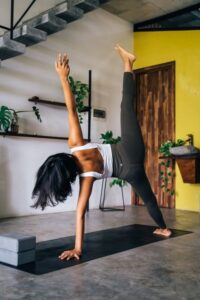
In short: revolved half moon is a one-leg standing balance with a twist. You stand on one leg, lift the other leg straight back at hip height, place the opposite hand on a block or the floor and turn the chest toward the standing leg. It asks for steady balance, hamstring length and core strength, so learn it with a block and a wall.
Where half moon opens the chest to the side, revolved half moon turns it the other way, so the pelvis faces the floor and the upper body rotates around the spine. Yoga Journal describes it as a pose that demands a lot from the hamstrings, pelvis, sacrum and lower back, and calls for considerable core strength. That makes it an intermediate-to-advanced balance, not a beginner pose.
The name
Parivṛtta means turned around or revolved, ardha half, candra (chandra) moon and āsana posture. The name appears in Yoga Journal’s master class by Tias Little and in the Iyengar Yoga teacher syllabus of Iyengar Yoga Canada, which lists Parivrtta Ardha Chandrasana among the standing poses. Yoga International teaches it under the same name, and the B.K.S. Iyengar Yoga Association of Vancouver has published a prop sequence for it. It is not among the postures of Light on Yoga (1966). The 26+2 series and the Bihar School use “half moon” for different postures (see the half moon page), but neither has a revolved version under this name.
How to make it work
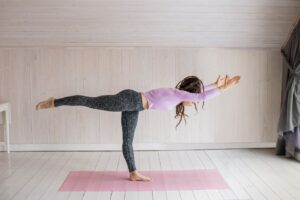
Set the standing leg before you twist. Yoga Journal’s sequence first builds the plain balance: the standing foot parallel to the edge of the mat, the big-toe mound pressing down, the arch lifted and the standing hip drawn in. Only then do both hip points turn to face the floor, with the opposite hand on a block in front of the standing foot. The back leg keeps the toes pointing down and reaches out through the centre of the heel; if that hip drops, lift it level again.
Twist from the length of the spine. Lengthen from tailbone to crown first, then rotate the chest toward the standing-leg side, leaving the pelvis square. Keep the top hand on the hip until the balance holds; reaching the arm up and looking at the hand come last. A slight bend in the standing knee keeps it from locking back. Most people need a block under the bottom hand for a long time, because a tight hamstring pulls the pelvis out of line when the hand reaches for the floor. Yoga International comes in from a lunge instead of triangle: float the back leg up into a modified warrior III with the fingertips on the floor or blocks, keep the back heel at hip height but not higher, which tends to strain the lower back, and start the twist from the back ribs, lifting the top arm only once the shoulders stack.
Precautions in plain words
Do not force the twist. With a lower back or sacroiliac problem, a hamstring injury, or a disc condition, skip the rotation or ask your doctor or physical therapist first. With neck problems, keep the gaze down. People with low blood pressure, dizziness or balance difficulties should stay close to a wall. In pregnancy, deep twists that compress the belly are usually avoided; an open version with the hand on a chair is a gentler option to discuss with your midwife or doctor. This page is general information, not individual advice.
Preparation and next poses
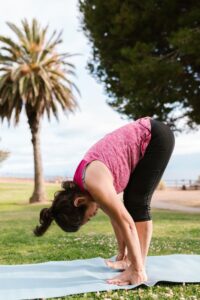
Useful preparation includes revolved triangle for the twist, pyramid pose for the hamstrings, and warrior III and half moon for the balance. Afterward, rest in a standing forward bend and repeat on the second side.
Where it is taught
Revolved half moon appears in Iyengar courses and in many vinyasa classes as a standing peak or a transition from revolved triangle. Explore more standing balances in the pose library.