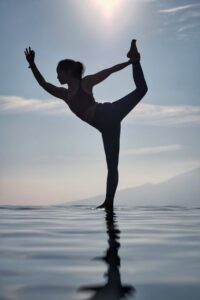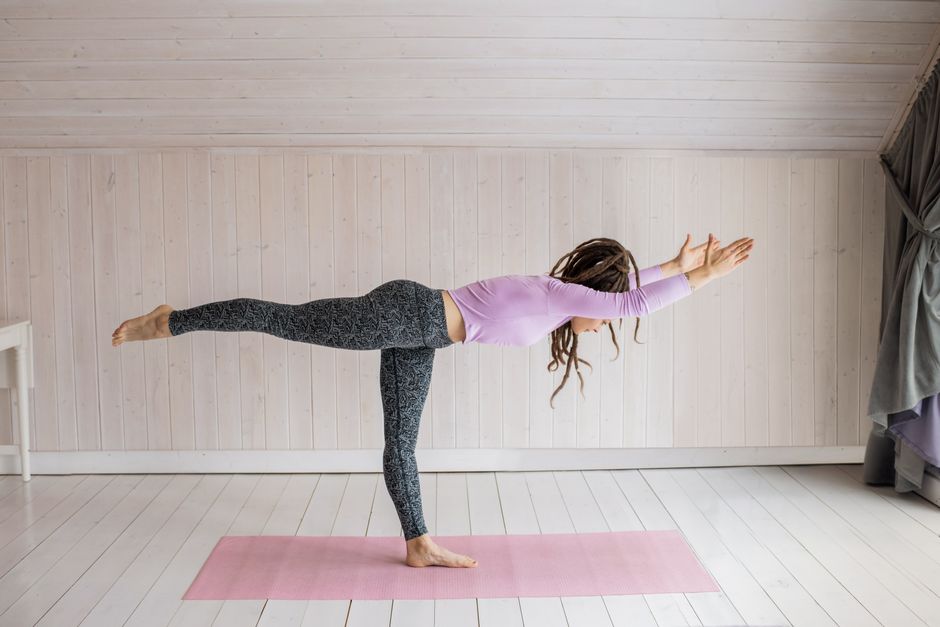
In short: warrior III is a one-legged balance in which the body tips forward until the arms, trunk and lifted back leg form one long line parallel to the floor, with the standing leg straight beneath you. It is a demanding balance that builds strength in the standing leg, hips and back. Learn it with the hands on a wall, a chair or blocks before letting go.
Warrior III looks calm in photographs and feels very busy from the inside: the standing leg works hard, the pelvis wants to tip open and the lower back wants to sag. That is why we class it as intermediate. Below we explain the name, how to build the pose, the precautions and how to use props.
The name
The Sanskrit name is Vīrabhadrāsana III, the third of the warrior poses named after the warrior Vīrabhadra (see warrior I for the story). Light on Yoga describes it as an intensified continuation of warrior I and rates it harder than warrior I and II. The Ashtanga primary series has warriors A and B (our I and II) but no warrior III, so this one is taught mainly through the Iyengar line and in modern vinyasa and hatha classes.
Making warrior III work
Light on Yoga builds the pose from warrior I: you bend forward, rest the chest on the front thigh with the arms stretched forward, take two breaths, then shift the weight forward, straighten the front leg and lift the back leg until the arms, trunk and back leg are parallel to the floor. Many teachers today enter from high lunge or with the hands on blocks. Whichever way you come in, move the weight forward slowly rather than kicking the leg up.
The key alignment is a level pelvis. As the back leg rises, its hip tends to lift and turn outward; Yoga Journal’s cue is to turn the inner thigh of the lifted leg toward the ceiling so the toes point down and both hip points face the floor. Firm the outer hip of the standing leg, keep that knee straight but not locked, and reach back through the heel as actively as you reach forward through the arms or the crown of the head. If the lower back hurts, bring the hands to the chest instead of reaching forward.
Using props to learn the balance
Yoga Journal offers four supported versions, and working through them in order is a good way to learn the pose:
- Hands on blocks. Rest the hands on blocks at any height instead of reaching forward. You can focus on the level hips without worrying about falling.
- Hands on a wall. Face a wall and press the palms into it as you tip forward. The leg may not lift very high, and that is fine.
- Hands on a chair. Rest the hands on the seat or back of a sturdy chair as you lift one leg behind you.
- Foot on a wall. Stand facing away from a wall and place the sole of the lifted foot on it, pressing into the heel. This teaches the strong reach back through the leg.
Two more cues from the same page help with common problems. Many people roll the torso slightly toward the standing-leg side or let that shoulder drop; turn the chest so it faces the floor squarely. And to protect the standing knee, imagine the calf resisting forward against the shin as you straighten the leg, so the knee does not lock. If the balance is shaky, bend the standing knee a little or lower the lifted leg: a lower center of gravity is more stable. Yoga Journal suggests 5 to 10 breaths; Light on Yoga gives 20 to 30 seconds with deep, even breathing. Come out slowly, the way you went in.
Precautions in plain words
This is a demanding balance, not a beginner pose. Practise near a wall or a sturdy chair, especially if you have balance problems, dizziness or a history of falls. Do not lock (hyperextend) the standing knee; bend it slightly if you feel strain behind it. With lower back pain, avoid letting the back arch, keep the hands at the chest, and lift the leg only a little. Come out at once if you feel faint. With high blood pressure, heart conditions, ankle or knee injuries, or in later pregnancy, ask your doctor and use a supported version.
Preparation and what comes next
Useful preparation: warrior I, high lunge, pyramid, chair pose and tree pose for standing balance. From warrior III you can open into half moon or fold toward standing split. Afterwards, rest in mountain pose or standing forward fold.
Where it is taught
Warrior III is in Iyengar yoga, and is common in vinyasa, power and hatha classes, usually in the standing-balance section of a sequence.