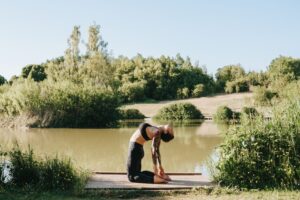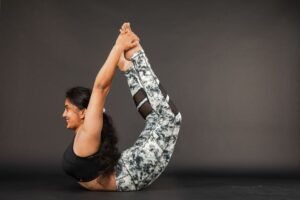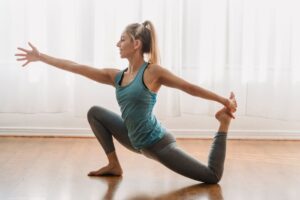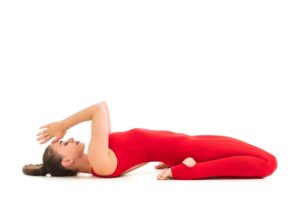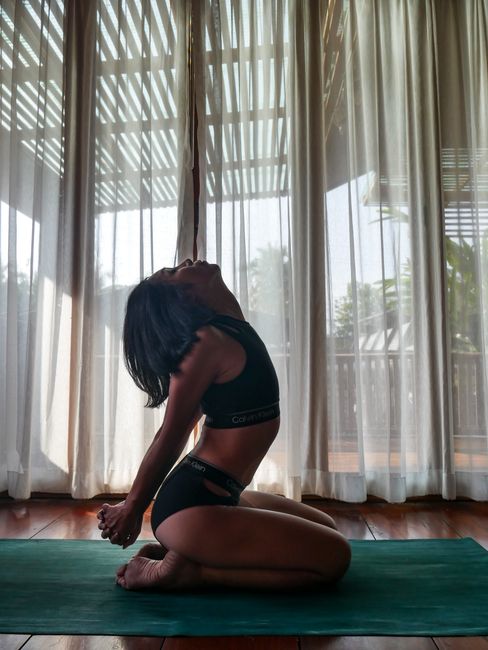
In short: little thunderbolt is an advanced kneeling backbend. Standing on the knees, you hold the legs and lower the body back, under control, until the crown of the head rests on the floor near the feet. Unlike camel, the hands do not support you on the heels: the front of the thighs and the belly hold the arch, so it asks for strength as well as flexibility. It belongs to the Ashtanga intermediate series and to Light on Yoga, and is learned with a teacher.
This page explains the name, the versions you will see, how the pose is approached, the precautions and the preparation. It is meant for recognition and understanding, not as a self-teaching guide.
The name
Laghu Vajrāsana joins laghu, which Iyengar glosses as little or easy (and also lovely), with vajra, the thunderbolt. Despite “little” and “easy”, it is not an easy pose: Light on Yoga rates it among the advanced backbends. It is a different posture from thunderbolt pose (Vajrāsana, sitting on the heels) and from reclining thunderbolt (Supta Vajrāsana).
How the pose is built, and how the grip has changed
In Light on Yoga you kneel with the knees and feet together, hands at the waist, then exhale, push the hips forward and arch back until the crown of the head rests on the feet, with the weight borne on the knees. Then the hands leave the waist and grip the knees with straight arms. Iyengar suggests holding 10 to 15 seconds; breathing is fast and laboured.
In the Ashtanga intermediate series it comes after camel and before Kapotasana. AshtangaYoga.info describes the current form with the hands holding the calves: you push the pelvis slightly forward, let the arms hang back, take the calves and lower yourself with control, activating the front of the thighs, until the bent elbows and the crown of the head rest on the floor, for five breaths. It notes that until the 2000s the hands held the front of the thighs, a deeper and more compact form, and that the calf grip asks for less flexibility but more strength. Coming up is harder than going down; sliding the hands from the calves to the thighs shortens the lever and helps you rise, pelvis first.
What makes the pose distinctive is that it is a strength pose as much as a stretch. AshtangaYoga.info describes it as an active stretch of the front of the body: the thighs and belly must work while they lengthen, so you control the movement through its whole range instead of hanging in it. That is also why the way up matters as much as the way down. If you cannot rise again without throwing the head or jerking, the descent went further than your strength, and a teacher will usually have you stop higher until it is controlled.
Precautions in plain words
Little thunderbolt loads the lower back, the knees and the neck. Learn it only with a teacher, after a steady camel and strong, flexible thighs. Avoid it with any back, knee or neck injury, in pregnancy, with high blood pressure or heart conditions, and with eye pressure problems. The head should touch the floor lightly; never drop onto it. If you cannot control the descent, stop higher and work on strength.
Preparation and what comes next
Prepare with camel, reclining hero, bow, low lunge for the hip flexors and wheel. A teacher may have you practise lowering partway back with the hands on the thighs and rising again. Little thunderbolt leads to Kapotasana. Afterwards, sit on the heels and rest forward in child’s pose.
Where it is taught
Little thunderbolt is part of the Ashtanga intermediate series and appears in Light on Yoga (Iyengar).