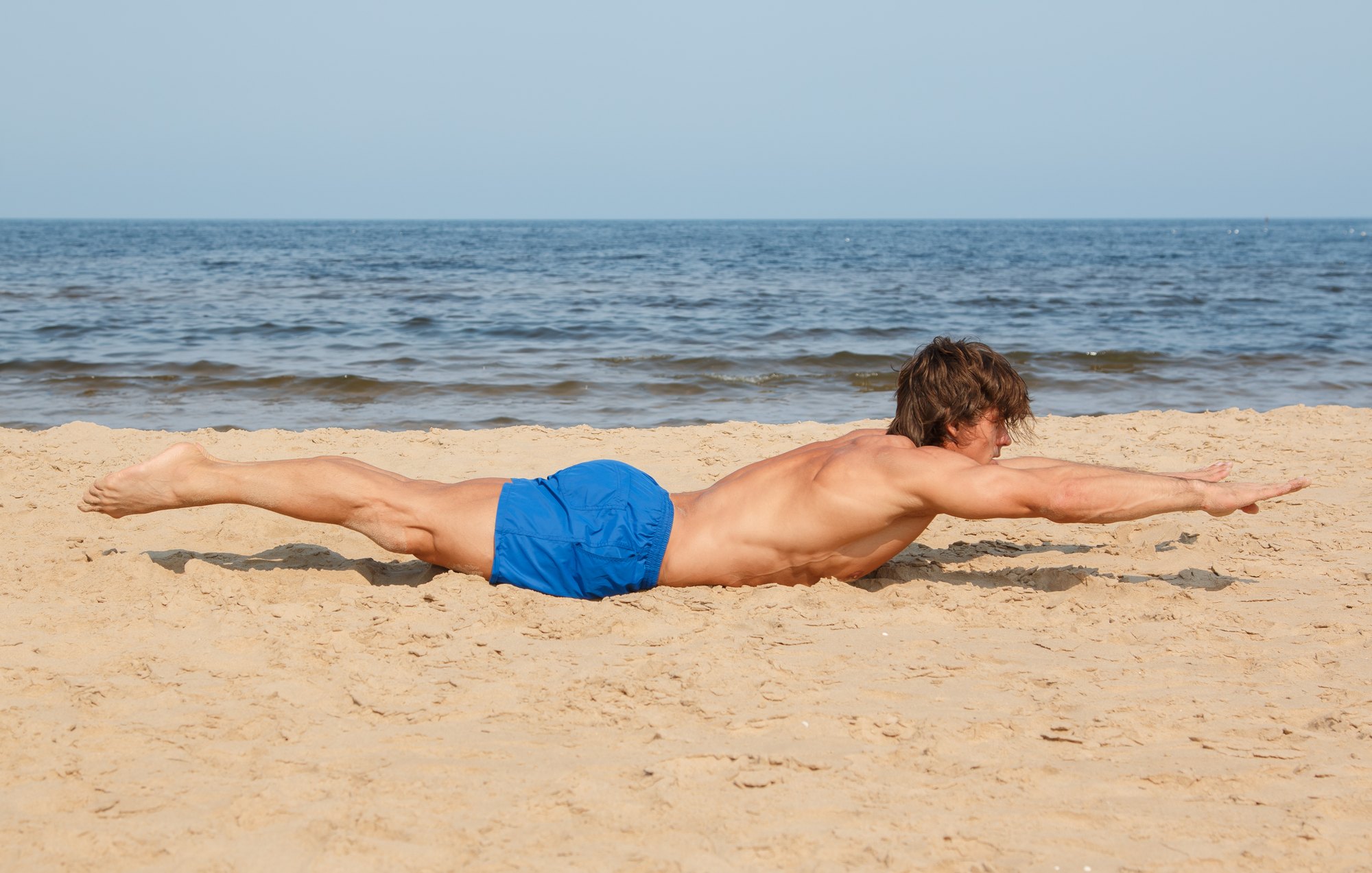
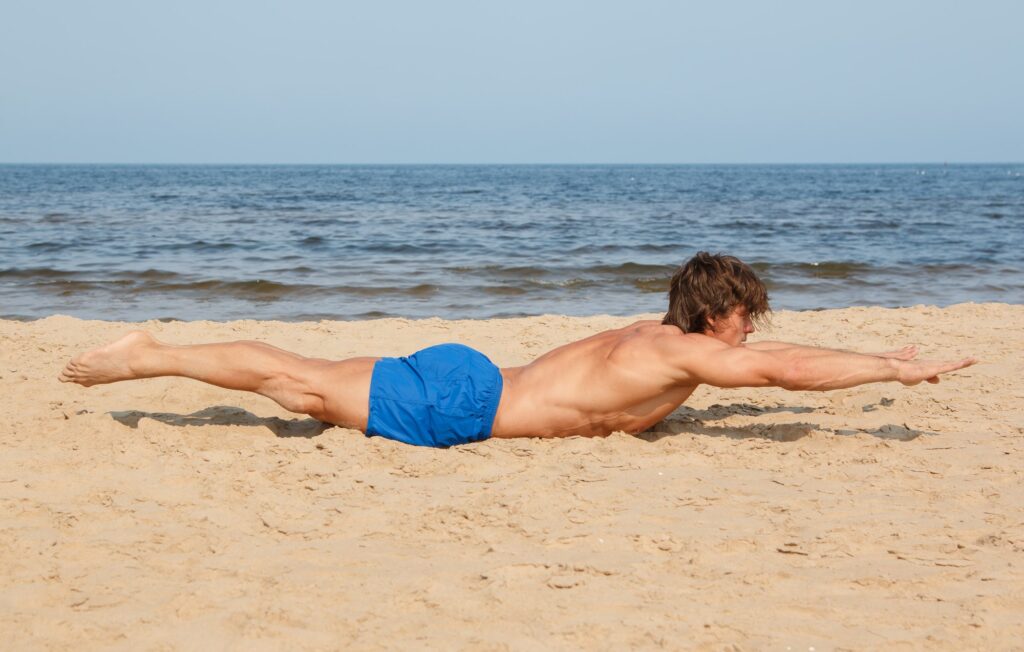
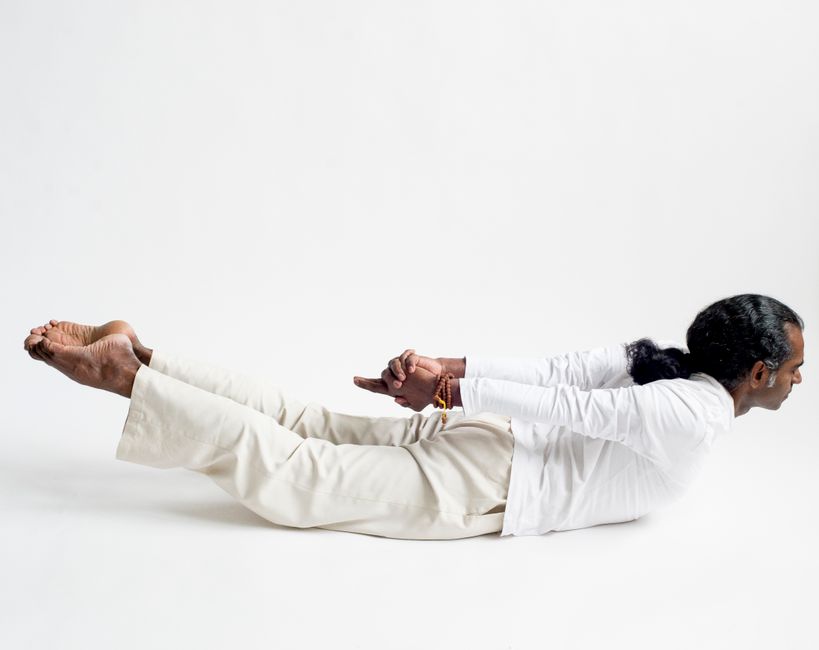
In short: locust pose is a backbend done lying on the belly in which the legs lift off the floor, and in many versions the head, chest and arms lift too. It is a strength pose for the whole back of the body: back muscles, buttocks and hamstrings. Different schools teach different arm positions, and the one-leg “half locust” is the usual way to start.
Locust looks modest, but holding it takes real effort. It belongs to the Sivananda twelve basic asanas, to the Ashtanga intermediate series and to most hatha classes. Below we explain the name, the main versions you will meet, the cues, the precautions, half locust and where the pose is taught.
The name, and the versions schools teach
The Sanskrit name is Śalabhāsana, from śalabha, locust or grasshopper; it is also spelled Shalabhasana. Iyengar says the shape resembles a locust resting on the ground. The name is stable, but the arm position varies:
- Arms back, chest and legs up. Light on Yoga lifts the head, chest and legs together with the arms stretched back and the hands off the floor, so only the belly bears the weight. Yoga Journal teaches a similar form.
- Legs up, chin and arms down. The Sivananda centres and the Bihar School keep the chin on the floor, the hands under the body as fists or clasped, and lift the straight legs; Sivananda describes a single strong contraction, like a locust jumping.
- Ashtanga A and B. In the Ashtanga intermediate series, Śalabhāsana A places the backs of the hands beside the thighs and lifts legs and chest; B bends the arms and places the palms on the floor beside the pelvis.
How to make locust work
Keep the legs straight and long and lift from the back of the body rather than by bending the knees. Yoga Journal asks you to press the toenails down first, rotate the inner thighs up to broaden the lower back, and avoid gripping the buttocks hard. Spread the effort along the whole spine: lift the breastbone, keep the back of the neck long and look slightly down rather than throwing the chin forward. In the Sivananda version, sliding the chin forward on the floor lengthens the neck. It is fine if the legs only rise a few inches; height comes with strength.
Breathing differs by school. Light on Yoga and Yoga Journal breathe normally; the Bihar School holds the breath in while the legs are up and says beginners may inhale as they lift. If you are new, keep breathing. Holds are short: Ashtanga takes five breaths, Sivananda at least ten seconds per side in half locust, and Light on Yoga as long as you can with normal breathing.
Half locust (Ardha Śalabhāsana): one leg at a time
Half locust lifts one straight leg while the other leg, the pelvis and the chin stay on the floor. The Bihar School places the hands under the thighs, palms down or as fists, and asks you not to tilt or twist the pelvis; Sivananda holds each side for at least ten seconds, three times per side, before the full pose; Yoga Journal offers a one-leg version with the forehead or chin down. The Bihar School also teaches a variation with the arms overhead, lifting one leg with the opposite arm. Half locust is the usual starting point for beginners and for stiff or weak backs.
Precautions in plain words
Locust is strenuous. The Bihar School advises against it with a weak heart, coronary thrombosis or high blood pressure, and with peptic ulcer or hernia; avoid holding the breath if any of these apply, and ask your doctor. With a back injury, a headache or a neck problem, Yoga Journal suggests modifying or skipping it; keep the forehead on a blanket to keep the neck neutral. Belly-down poses are usually avoided in pregnancy. Stop if the lower back pinches and come back to half locust.
Preparation and what comes next
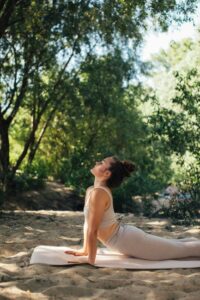
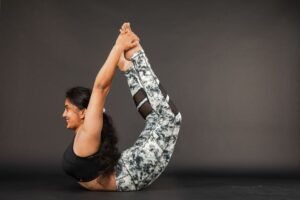
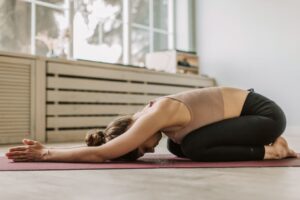
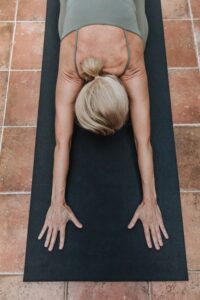
Prepare with sphinx and cobra. In the Sivananda order and in the Bihar School’s advice, locust comes after cobra and before bow; in Ashtanga it is followed by Bhekāsana and bow. Rest afterwards in child’s pose or lying on the belly with the head turned to one side.
Where it is taught
Locust is in the Sivananda twelve basic asanas, in Light on Yoga (Iyengar), in the Ashtanga intermediate series, in the 26-posture hot yoga sequence and in many hatha and vinyasa classes.