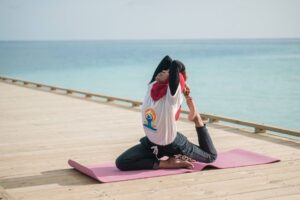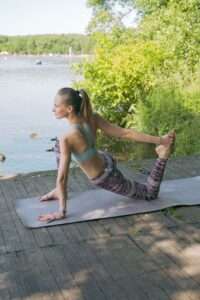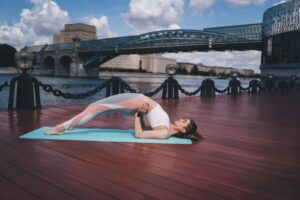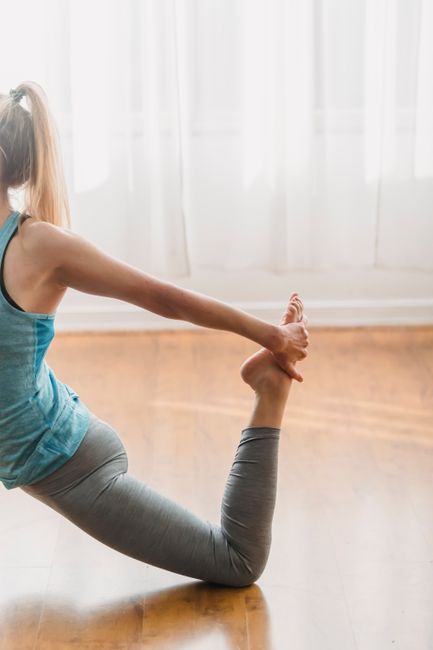
In short: one-legged king pigeon, Eka Pada Rajakapotasana, is the full version of the pigeon shape: the front leg folds on the floor, the back knee bends, and both hands reach overhead to hold the back foot while the chest lifts and the head drops back toward it. It is a deep backbend combined with a deep hip opener, an advanced pose to learn with a teacher after the simpler pigeon pose is comfortable.
Most people know only the first half of this pose. The pigeon taught in most classes, front leg folded and back leg straight, is what B.K.S. Iyengar calls the preparatory movement of One-Legged King Pigeon I. The full pose adds the back foot drawn up to the head, which needs open hip flexors and thighs, a flexible upper back and shoulders that can rotate the arms overhead. Light on Yoga then describes three more variations, II to IV, which change what the legs do. All four are on this page.
The name
Eka means one, pāda foot or leg, rāja king and kapota pigeon or dove. Light on Yoga explains that the chest is pushed forward like that of a pouter pigeon, which gives the pose its name. The numbering I to IV used here is Iyengar’s; Yoga Journal uses the same name and numbering for versions I and II. In the Ashtanga system, the pose appears in the third (advanced A) series as documented by AshtangaYoga.info. Do not confuse it with Kapotasana, the kneeling pigeon backbend in which both hands hold the heels, or with Rajakapotasana, the king pigeon done lying on the belly with both feet drawn to the head.
How to make it work
Build the pose in stages. First set the legs as in pigeon, front heel near the groin, back leg straight, and lift the chest with the hands on the waist; this upright stage is already a backbend. Then bend the back knee and catch the back foot with the hand on the same side, or with a strap looped around the foot. Yoga Journal’s challenge-pose sequence suggests the strap, and taking the arm back with a bent elbow, turning it up and over so the elbow points to the ceiling, rather than yanking a straight arm behind you. Only when one hand holds the foot comfortably does the second arm join, and only then does the head move back toward the sole. The lift comes from the chest and upper back; if the lower back pinches, you are bending from the wrong place.
Precautions in plain words
This is an advanced backbend. Avoid it with lower-back, sacroiliac, knee, shoulder or neck injuries, and with high blood pressure or heart problems unless a health professional has cleared you. The front knee carries the same risk as in pigeon: stop at any knee pain. Light on Yoga notes that the breathing becomes fast in the full pose because the chest is fully expanded; try to keep it smooth and come out if you start to strain or feel dizzy. Not recommended in pregnancy. Learn it with an experienced teacher. This page is general information, not individual advice.
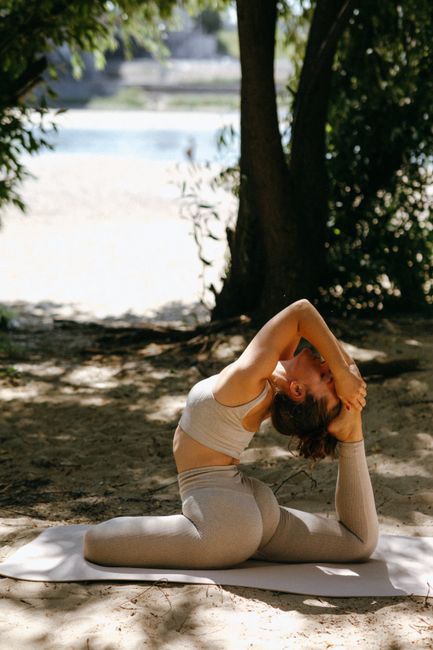
One-Legged King Pigeon II (Eka Pada Rajakapotasana II)
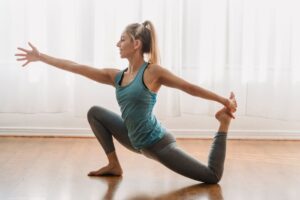
In version II the front foot stands flat on the floor, shin roughly vertical as in a lunge, while the back knee rests on the floor; the back shin lifts, both hands reach overhead to hold the back foot and the head rests against it. Light on Yoga describes the front leg as in Marichyasana I with the front knee pushed forward, and holds for about 15 seconds; Yoga Journal gives the same shape with 15 to 30 seconds and suggests a strap and practising with the back shin against a wall. Iyengar notes that once the balance is found it is easier than version I. Advanced.
One-Legged King Pigeon III (Eka Pada Rajakapotasana III)
In version III the front leg is folded back beside the hip as in hero pose, toes pointing back, while the other leg stretches straight behind; that back knee then bends and both hands take the foot to the head, held for about 15 seconds in Light on Yoga. The hero-pose leg makes this a strong knee position as well as a deep backbend; only practise it if hero pose is easy for you. Advanced. This version is documented in Light on Yoga; we have not yet found a second independent description.
One-Legged King Pigeon IV (Eka Pada Rajakapotasana IV)
Version IV starts from the full front split, monkey pose: from the split, the back knee bends, the foot is lifted toward the head and caught with both hands overhead, for about 10 seconds in Light on Yoga, which rates it among the hardest of the series. It requires a comfortable split on both sides plus a deep backbend. Very advanced; learn it only with a teacher. Like version III, it is documented here from Light on Yoga alone.
Preparation, counterposes and where it is taught
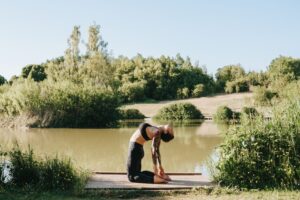
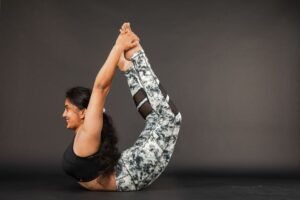
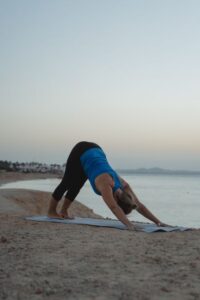
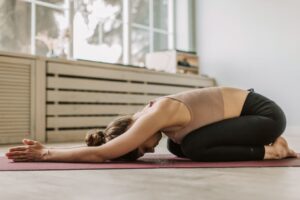
Prepare with pigeon pose, low lunge with the back knee bent, camel pose, bow pose and reclining hero pose. Afterward, neutralise the spine gently: child’s pose, a simple twist such as reclining spinal twist and downward-facing dog. The pose belongs to advanced Iyengar and Ashtanga practice and to backbend workshops in vinyasa; our wheel pose preparation plan builds many of the same openings.