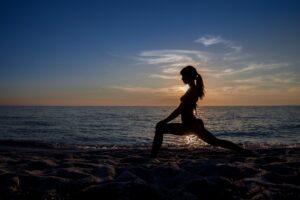
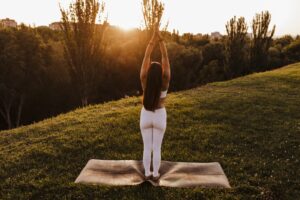
Sun Salutation B in the Ashtanga order: chair pose, Warrior I on the right and left, the 17 counted movements with their breath, and five breaths in the last downward dog.
Origin and source
The second of the two sun salutations taught by K. Pattabhi Jois at the start of Ashtanga practice (Yoga Mala); order and counts as published in lineage teaching material (AshtangaYoga.info, Dr. Ronald Steiner).
Who it is for
Comfortable with Sun Salutation A, chair pose and Warrior I. Strength for repeated chaturanga (or the knees-down version).
The steps in order
Version shown: Ashtanga order, 17 vinyasa counts, right side first, five breaths in the last downward dog (AshtangaYoga.info vinyasa sheet, 2004)
| # | Step | Count | Breath | Side | Hold | Cues and options |
|---|
| 1 |  Samasthiti
Tāḍāsana | | Free breathing | | | Transition: Feet together, arms by the sides. Easier option: Feet hip-width apart. |
| 2 | 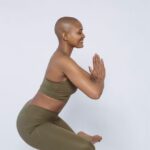 Chair pose (Utkatasana)
Utkaṭāsana | 1 (Ekam) | Inhale | | | Transition: Bend the knees and sweep the arms up, gaze to the thumbs. Easier option: Bend the knees less; arms shoulder-width apart. |
| 3 | 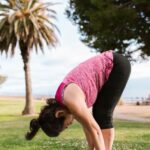 Standing forward fold
Uttānāsana | 2 (Dve) | Exhale | | | Transition: Straighten the legs as you fold. Easier option: Knees bent; hands on blocks. |
| 4 | 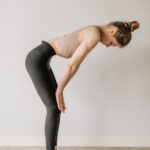 Head up
Ardha Uttānāsana | 3 (Trīṇi) | Inhale | | | Transition: Lengthen the spine, look forward. Easier option: Hands on shins. |
| 5 | 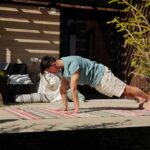 Jump or step back to Chaturanga
Caturaṅga Daṇḍāsana | 4 (Catvāri) | Exhale | | | Transition: Land and lower in one movement. Easier option: Step back; knees down. |
| 6 | 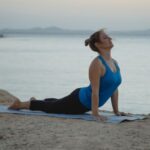 Upward-facing dog
Ūrdhva Mukha Śvānāsana | 5 (Pañca) | Inhale | | | Transition: Roll over the toes, lift the chest. Easier option: Cobra. |
| 7 | 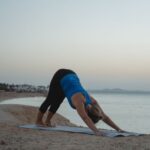 Downward-facing dog
Adho Mukha Śvānāsana | 6 (Ṣaṭ) | Exhale | | | Transition: Pass through; turn the left heel in to prepare the right-side warrior. Easier option: Knees bent. |
| 8 | 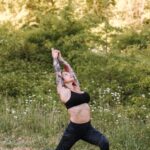 Warrior I (Virabhadrasana A), right foot forward
Vīrabhadrāsana I | 7 (Sapta) | Inhale | Right | | Transition: Step the right foot between the hands, bend the right knee, rise with the arms overhead. Easier option: Back knee down (low lunge); hands on the front thigh. |
| 9 | Chaturanga
Caturaṅga Daṇḍāsana | 8 (Aṣṭau) | Exhale | | | Transition: Hands down either side of the front foot, step back and lower. Easier option: Knees down. |
| 10 | Upward-facing dog
Ūrdhva Mukha Śvānāsana | 9 (Nava) | Inhale | | | Transition: Lift the chest. Easier option: Cobra. |
| 11 | Downward-facing dog
Adho Mukha Śvānāsana | 10 (Daśa) | Exhale | | | Transition: Pass through; turn the right heel in. Easier option: Knees bent. |
| 12 | Warrior I, left foot forward
Vīrabhadrāsana I | 11 (Ekādaśa) | Inhale | Left | | Transition: Step the left foot forward and rise. Easier option: Back knee down. |
| 13 | Chaturanga
Caturaṅga Daṇḍāsana | 12 (Dvādaśa) | Exhale | | | Transition: Hands down, step back and lower. Easier option: Knees down. |
| 14 | Upward-facing dog
Ūrdhva Mukha Śvānāsana | 13 (Trayodaśa) | Inhale | | | Transition: Lift the chest. Easier option: Cobra. |
| 15 | Downward-facing dog
Adho Mukha Śvānāsana | 14 (Caturdaśa) | Exhale | | 5 breaths
Ashtanga (AshtangaYoga.info vinyasa sheet) | Transition: Hips up, gaze to the navel. Easier option: Knees bent; rest in child's pose if needed. |
| 16 | Jump or step forward, head up
Ardha Uttānāsana | 15 (Pañcadaśa) | Inhale | | | Transition: Jump or step forward, lift the head. Easier option: Walk the feet in. |
| 17 | Standing forward fold
Uttānāsana | 16 (Ṣoḍaśa) | Exhale | | | Transition: Fold. Easier option: Knees bent. |
| 18 | Chair pose
Utkaṭāsana | 17 (Saptadaśa) | Inhale | | | Transition: Bend the knees and rise with the arms up. Easier option: Less depth. |
| 19 | Samasthiti
Tāḍāsana | | Exhale | | | Transition: Straighten the legs, lower the arms. Easier option: Pause between rounds. |
Left and right
Warrior I with the right foot forward first (count 7), then the left foot forward (count 11), inside every round.
Repetitions and counting
One round = 17 counts with both sides; Samasthiti at start and end is not counted. Ashtanga sources give five rounds after five rounds of A.
Props and adaptations
Step instead of jumping; knees down for chaturanga; cobra for upward dog; back knee on the floor in the warrior; shallower chair pose; blocks under the hands in the folds.
Precautions
- Three chaturangas per round load the shoulders and wrists: reduce rounds or use the knees-down option if they ache.
- Knee problems: keep chair pose shallow and the front knee over the ankle in Warrior I.
- High blood pressure, glaucoma, pregnancy: check with a health professional and a qualified teacher first.
Learn it with a teacher: Learn the step-through into Warrior I and the transitions in a led or Mysore-style class; a teacher can set how many rounds you do.
General information, not medical advice. Poses do not cure illness. If you are pregnant, injured or have a health condition, check with your doctor and tell your teacher before you practise.
Sun Salutation B around the world
Share your Sun Salutation B, wherever you are
Sun Salutation B (Surya Namaskara B) is the second sun salutation of Ashtanga vinyasa yoga, practised straight after Sun Salutation A. It keeps the same backbone, a fold, a jump back, chaturanga, upward dog and downward dog, but adds chair pose (Utkatasana) at the start and end and Warrior I (Virabhadrasana A in Ashtanga) on the right and then the left. The result is longer, stronger and warmer.
The order, breath and counts below follow Ashtanga lineage teaching material (see Sources). Other styles use B-like sequences with different holds; those are variations, not this order.
The order in brief
From Samasthiti: chair pose, forward fold, head up, jump back to chaturanga, upward dog, downward dog; step the right foot forward into Warrior I; chaturanga, upward dog, downward dog; step the left foot forward into Warrior I; chaturanga, upward dog, downward dog for five breaths; jump forward, head up, fold, chair pose, and back to Samasthiti.
How the 17 counts work
Ashtanga counts movements (vinyasas), one per breath, not the shapes you hold. Sun Salutation B has 17 vinyasas. The first six mirror A, except that count 1 is chair pose instead of arms up. Counts 7 to 10 are the right-side warrior and the linking vinyasa (chaturanga, upward dog, downward dog). Counts 11 to 14 repeat that with the left leg forward. Downward dog at count 14 is the one long hold, five breaths. Counts 15 to 17 bring you forward, into the fold and up into chair pose; the final exhale back to Samasthiti is not counted, just as in A.
Two details trip people up. First, the downward dogs at counts 6 and 10 are not held: you pass through them on one exhale and step forward into the warrior on the next inhale. Second, how you get the back heel down and the foot forward into Warrior I is not a counted movement of its own; it happens inside the inhale of counts 7 and 11. Many teachers tell students to turn the back heel down first, then step, so the knee and hip are not twisted as the weight arrives.
Rounds and sides
One round includes both sides, right first, then left. The Ashtanga sources we used give five rounds of B after five rounds of A; beginners in Mysore-style classes are commonly given fewer at first, at the teacher’s discretion. Keep the ujjayi breath steady throughout; if the breath gets short, the round is too fast.
How to practise it safely
B asks for everything A does, plus sustained leg strength and three trips through chaturanga in each round. That is a lot of load on the shoulders and wrists, so quality matters more than speed. In chair pose, keep the knees tracking over the toes and the weight in the heels. In Warrior I, a shorter stance makes it easier to square the hips and keep the front knee over the ankle. If the knees complain in chair pose, rise higher; if the lower back complains in Warrior I, shorten the stance and lift the belly.
The same precautions as A apply: ask a teacher or health professional first with wrist, shoulder, knee or lower-back problems, uncontrolled blood pressure or glaucoma, and in pregnancy. Stop with sharp pain or dizziness.
Easier alternatives
Step between the poses instead of jumping, lower with the knees down, use cobra in place of upward dog, and drop the back knee to the floor in the warrior (a low lunge) if the full stance is too much. The beginner sun salutation, gentle standing sun salutation and chair sun salutation are complete alternatives. The pose pages for chair pose and Warrior I give the alignment in detail.
Where it is taught
B is part of the fixed opening of every Ashtanga practice (see the Ashtanga series overview). Many vinyasa and power classes borrow it, often holding the warriors longer or adding Warrior II; those are teacher variations.