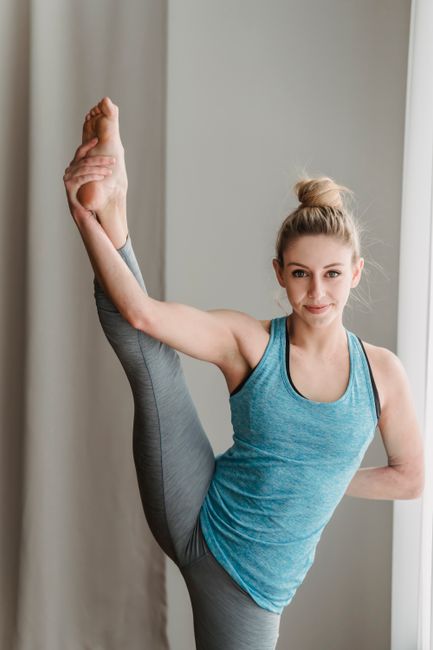
In short: extended hand-to-big-toe pose is a standing balance in which you lift one leg forward, hold its big toe and extend the leg toward hip height or higher. It works balance and the backs of the legs. A strap, a bent knee or a chair makes it practical for most people; the folded and hands-free versions are for experienced practitioners.
This pose shows very quickly whether the standing leg is doing its job: the moment the lifted leg straightens, the pelvis wants to tip and the standing hip wants to drift out. Learning to hold both still is the real work. Below we explain the name, how different traditions build the pose, the cues behind the steps and the revolved variation.
The name and how traditions teach it
Utthita means extended, hasta hand and pādāṅguṣṭha big toe. In Light on Yoga (1966) the pose builds in stages: holding the big toe with the knee bent, stretching the leg forward, lifting it higher with both hands and finally resting the chin beyond the knee. Iyengar notes that the last stages cannot be balanced without first mastering the extended leg. The Bihar School’s Asana Pranayama Mudra Bandha describes a basic forward form, a two-handed version drawing the leg toward the head and a version with the leg out to the side, holding each for up to 60 seconds. Yoga Journal teaches the forward form and the side version for general classes.
In the Ashtanga standing sequence the pose is a fixed multi-part flow, as documented by AshtangaYoga.info: the leg goes forward and the torso folds over it; then the leg opens to the side (Utthita Pārśvasahita); then it returns to the front and is held up without the hands, hands on the hips, for five breaths. AshtangaYoga.info notes that Pattabhi Jois introduced the pose only after a student had learned the reclining version near the end of the Primary Series, which is a useful hint about its difficulty.
How to make it work
Root the standing foot and firm the standing thigh without pushing the knee back. Keep the natural curve of the lower back: if the hamstrings are tight, the pelvis tucks and the spine rounds as soon as the leg straightens, which is the cue to bend the knee or use a strap. Yoga Journal’s teaching tips are to keep the pelvis level, without hitching up the lifted-leg side, and to stop the standing hip sliding away from the midline by engaging the buttock. Press the lifted foot forward into the hand or strap rather than pulling the leg toward you.
Revolved hand-to-big-toe pose (Parivṛtta Hasta Pādāṅguṣṭhāsana)
In the revolved variation, the lifted leg is held in front by the opposite hand, and the torso turns toward the lifted leg while the free arm reaches back at shoulder height. The setup and grip are the same as the forward form, so it lives on this page. It adds a twist to an already demanding balance and is an advanced variation: the pelvis must stay level while the chest rotates, and tight hamstrings make that very hard. Learn it with a strap around the foot first, and only once the forward form is steady. We have not yet confirmed this variation in two of our reference sources, so treat the description as general guidance until it is checked.
Precautions in plain words
Do not force a straight leg: a bent knee or strap protects the hamstring attachment at the sitting bone. With a hamstring injury, lower back pain, sciatica or a hip condition, keep the leg low or practise the reclining version, and check with your doctor or physical therapist. If balance is unreliable, rest the lifted foot on a chair. In pregnancy, a wall or chair for support is advisable; ask your midwife or doctor. This page is general information, not individual advice.
Preparation and next poses
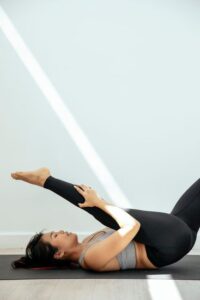
Prepare with reclining hand-to-big-toe pose, which teaches the same leg action without the balance, plus tree pose and standing forward bend. In the Ashtanga order the next pose is half-bound lotus standing forward bend. Bird of paradise uses the same side-leg extension with a bind.
Where it is taught
You will find it in Ashtanga, Iyengar, vinyasa and hatha classes. Browse other standing balances in the pose library.