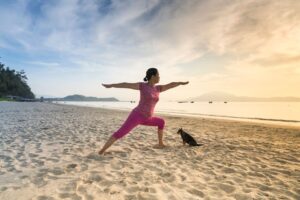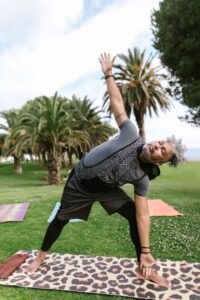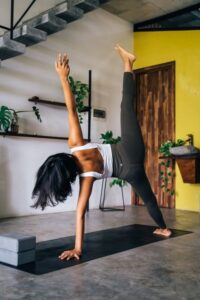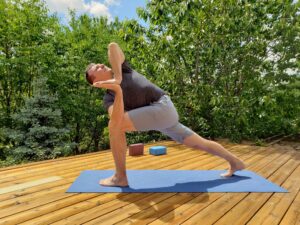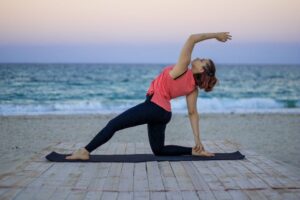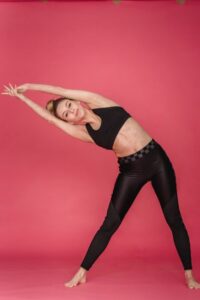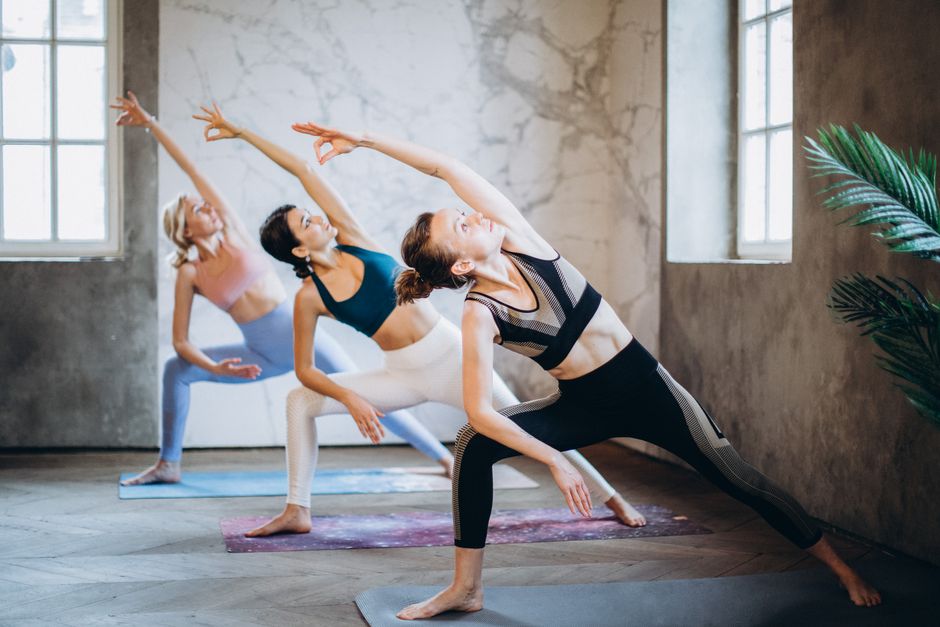
In short: extended side angle starts from a warrior II stance: the front knee bends to a right angle, the lower hand or forearm comes down beside the front leg, and the top arm reaches over the ear so that one long line runs from the outer edge of the back foot to the top fingertips. It strengthens the legs and stretches the whole side of the body. Use a block or the forearm on the thigh until the chest can stay open.
Below we explain the name, the cues behind the steps, the precautions, and the bound variation, which is covered in its own section further down this page rather than on a separate page.
The name
The Sanskrit name is Utthita Pārśvakoṇāsana. In Light on Yoga, pārśva is the side or flank and koṇa an angle, and utthita means extended: the extended lateral angle pose. Iyengar rates it Four*. In the Ashtanga standing sequence it follows the two triangles and is sometimes called Parsvakonasana A, with the revolved version as B. The twisting form has its own page, revolved side angle.
Making extended side angle work
Build it in three stages, as Yoga Journal suggests: legs, then arms, then the turn of the chest. Take a wide stance (Iyengar gives 4 to 4½ feet) with the ankles roughly under the wrists when the arms are out, front foot turned out 90 degrees and back foot slightly in. Bend the front knee toward a right angle, thigh parallel to the floor and knee over the heel, and keep the back leg straight with the outer edge of the back foot pressing down. Bending fully to a right angle shares the work between both legs.
Then lower the front-side hand. In Light on Yoga the palm goes to the floor outside the front foot with the armpit covering the outer knee; most people start with the forearm resting on the front thigh or the hand on a block. Do not slump onto the thigh: press the arm down and lift the side of the trunk away from it. Take the top arm over the ear, turn the chest toward the ceiling and reach from the back heel through the fingertips. Iyengar gives half a minute to a minute; Ashtanga five breaths.
Precautions in plain words
Keep the front knee over the heel and pointing over the foot. With knee or hip problems, bend less and use the forearm-on-thigh version. With shoulder problems, keep the top hand on the hip. If turning the head to look up strains the neck, look forward or down.
Bound side angle (Baddha Pārśvakoṇāsana)
In bound side angle the legs stay exactly as above, but the arms wrap: the lower arm threads under the front thigh, the top arm reaches behind the back, and the hands meet around the outer hip of the front leg. Yoga International describes holding a strap or towel between the hands, clasping the fingers, or holding one wrist, and making sure the bind lands around the outer buttock of the front leg. It is a preparation for bird of paradise.
The bind asks a lot of the shoulders, especially the top shoulder rolling back and in. Use a strap rather than forcing the hands together, keep the chest turning up rather than collapsing onto the thigh, and come out if you feel pinching at the front of the shoulder. Skip the bind with a shoulder injury. We class this variation as intermediate.
Preparation, next poses and where it is taught
Prepare with warrior II and triangle; reverse warrior stretches the other side. From here you can move to half moon, the bound version above, or revolved side angle. The pose is taught in Iyengar yoga, the Ashtanga standing sequence and most hatha and vinyasa classes.