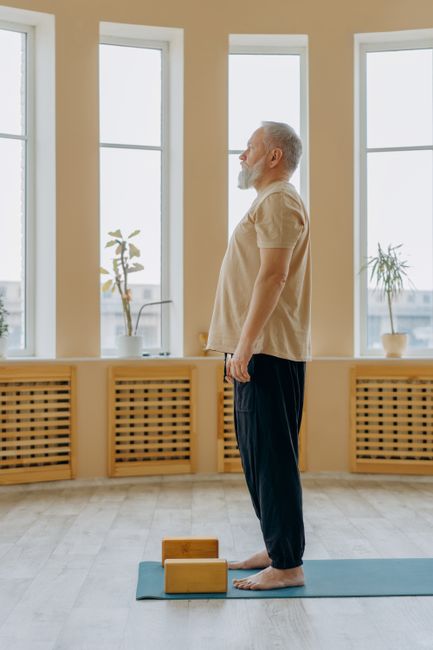
In short: mountain pose is the basic standing posture of yoga: feet together or hip-width apart, weight spread evenly over both feet, legs active, spine tall and arms relaxed by your sides. It looks like simply standing still, but it is where almost every standing pose starts and ends, and the place where you learn how you actually stand.
Most of us stand with the weight thrown onto one leg, the heels or the outer edges of the feet. Mountain pose asks you to notice that and come back to the middle. B.K.S. Iyengar opens the standing poses of Light on Yoga with it and calls it the basic standing pose; Yoga Journal describes it as the cornerstone of the standing poses. Below we explain the two names it goes by, the cues behind the steps and how it is used in different schools.
Tadasana and Samasthiti: one pose, two names
The Sanskrit name is Tāḍāsana, usually written Tadasana: tāḍa is a mountain and āsana a seat or posture (see what asana means). Light on Yoga gives it as “Tadasana (also called Samasthiti)”. Samasthiti joins sama (even, upright, unmoved) and sthiti (standing still, steadiness), so it describes the even, steady quality of the pose.
In Ashtanga vinyasa, Samasthitiḥ is the name of the attention position, feet together and hands by the sides, that opens and closes each sun salutation and each standing posture. India’s Common Yoga Protocol (Ministry of Ayush) also says the standing start position is called Samasthiti or Tadasana. Two schools use “Tadasana” for something else: in the Bihar School of Yoga’s Asana Pranayama Mudra Bandha and in the Common Yoga Protocol, Tadasana is translated “palm tree pose” and is done with the arms overhead, rising onto the toes. That stretch is a different exercise; on this page we mean the even, flat-footed standing pose. The Bihar side-bending version is on our swaying palm tree page.
Making mountain pose work
Start from the feet. Iyengar asks you not to bear the weight on either the heels or the toes but to spread it evenly; Yoga Journal suggests rocking forward and back and side to side, then letting the sway settle until you are balanced over the whole foot. From there, stack ankles, knees, hips and shoulders in one line. The legs are awake rather than locked: if your knees tend to push back (hyperextend), keep a micro-bend.
The upper body stays tall without stiffening. Let the shoulders settle away from the ears and the chest open, and avoid the old cue to tuck the tailbone hard, which flattens the lower back and pushes the hips forward. Breathe slowly through the nose. If standing with the feet together feels wobbly or strains the lower back, take the feet hip-width apart: Iyengar notes that even with the feet apart it is better to keep heel and toe in line rather than turned out.
Precautions in plain words
Mountain pose is safe for nearly everyone, but standing still for a long time can make some people light-headed. If you feel dizzy, widen the stance, keep a slight bend in the knees, keep breathing, or sit down. With balance problems, practise with your back to a wall or beside a chair. During pregnancy, stand with the feet hip-width or wider. This page is general information, not individual advice.
Preparation and what comes next
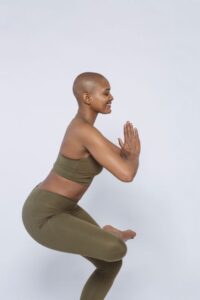
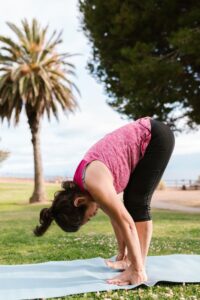
Mountain pose needs no preparation; a few breaths of attention to the feet are enough. It leads naturally into upward salute (arms overhead), standing forward fold, chair pose and tree pose, and it is the place to come back to between standing poses to feel what the last one did.
Where it is taught
You will meet it in practically every style: as Tadasana in Iyengar and hatha classes, as Samasthiti at the start and end of every sun salutation in Ashtanga, and as the quiet standing pause in vinyasa flows. Browse more standing postures in the yoga pose library.