In short: five-pointed star is a simple standing pose: feet wide apart, legs straight and active, arms stretched out to the sides at shoulder height (or up in a V), so the head, hands and feet make the five points of a star. It wakes up the whole body, opens the chest and is a natural starting point for wide-legged poses. It is short and accessible; the main work is reaching out evenly in every direction.
Star pose is often used to set up the wide-legged standing poses or as a playful, energising shape in children’s and family classes. Below we explain the name, how to make the pose more than just standing wide, the precautions and where it leads.
The name: a modern pose
Five-pointed star, or star pose, is a modern descriptive name. Yoga Journal and Yoga International both use it, and Yoga Journal labels it Utthita Tāḍāsana (“extended mountain”); because that label does not come from the traditional texts we checked, we list it as modern usage. In Light on Yoga the same wide stance with the arms out at shoulder height appears only as the set-up position for poses like triangle and warrior II, without a name of its own.
That set-up is worth knowing, because it is where star pose comes from in many classes. In Light on Yoga, Iyengar starts several standing poses the same way: from mountain pose, take a deep inhalation and jump the legs apart, then raise the arms sideways in line with the shoulders, palms facing down, arms parallel to the floor. For triangle and revolved triangle he spreads the feet about 3 to 3½ feet apart; for extended side angle and warrior II, about 4 to 4½ feet. So when you stand in star pose, you are practicing the base that these poses grow from.
Making star pose work
Step the feet wide, roughly under the wrists when the arms are stretched out, as Yoga Journal describes. Yoga International turns the toes out slightly; parallel feet are fine too. Keep the legs straight but not locked and lift the arches. Stretch the arms out to the sides at shoulder height, or up into a wide V with the fingers spread, as Yoga International does.
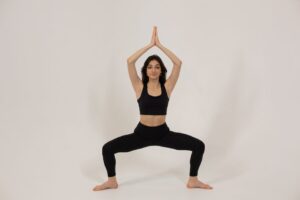
Now make it active: reach strongly through all five points at once, the crown of the head up, the hands out, the feet down and away from each other, while the shoulders stay relaxed and the chest gently open. Breathe deeply. Hold for a few breaths, or use it as a moving pose: Yoga International pairs it with goddess pose, bending the knees on an exhalation and returning to the star on an inhalation.
Start from the feet. In his notes on mountain pose, Iyengar warns against standing with the weight only on the heels or on the edges of the feet, and suggests spreading the weight evenly between heels and toes. The same idea helps here: press the big-toe side and the little-toe side of each foot down equally, and feel the outer edges of the feet stay grounded as the arches lift. He also notes that when the feet are apart it is better to keep each heel and toe in a line, rather than turned out at an angle, so try parallel feet first and then experiment with a slight turn-out to see which feels steadier in your knees.
Then work upward. Firm the thighs without pushing the knees back. Let the tailbone drop gently so the lower back is not arched, and keep the front ribs from flaring forward as the arms lift. Reach through the fingertips as if someone were gently pulling each hand away from you, while the shoulder blades stay wide and low on the back.
- Shoulders creeping up to the ears: lower the arms a little, or turn the palms up, and let the neck stay long.
- Locked knees: keep a tiny softness behind the knees so the thigh muscles do the work.
- Arched lower back: draw the lower belly in gently and let the ribs settle over the hips.
- Holding the breath: star pose should feel open and easy. Keep the breath full and steady.
A few slow breaths are enough when you use star pose on its own. In a flowing class it may last only one breath before you bend the knees into goddess or turn a foot for warrior II. Sitting on a chair, you can do the same reach with the arms out or up in a V and the feet wide and flat on the floor.
Precautions in plain words
Star pose is safe for most people. With shoulder problems, keep the arms lower or the hands on the hips. Do not lock the knees. On a slippery floor, a wide stance can slide: use a non-slip mat. With groin or inner-thigh injuries, take a narrower stance. If balance is uncertain, stand with your back near a wall. People who feel dizzy with the arms raised for long can bring the hands to the hips between breaths, and anyone with a recent shoulder or hip injury should ask their doctor or physical therapist which positions are safe.
Preparation and what comes next
No special preparation is needed beyond mountain pose. From star pose you can bend the knees into goddess, turn one foot out for warrior II or triangle (as Yoga Journal’s sequence does), or fold into wide-legged forward fold.
Where it is taught
Five-pointed star is used in modern vinyasa and hatha classes, in many children’s and family yoga sessions, and seated on a chair (arms in a V, feet wide) in chair yoga.