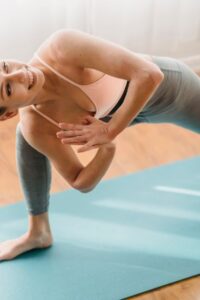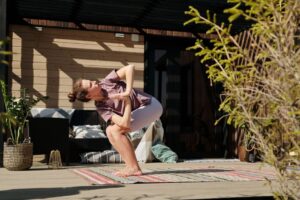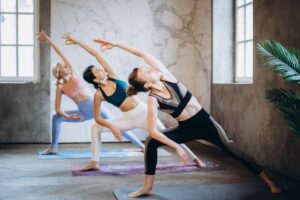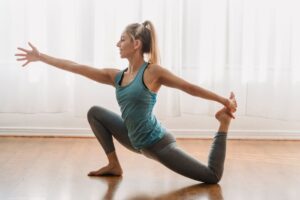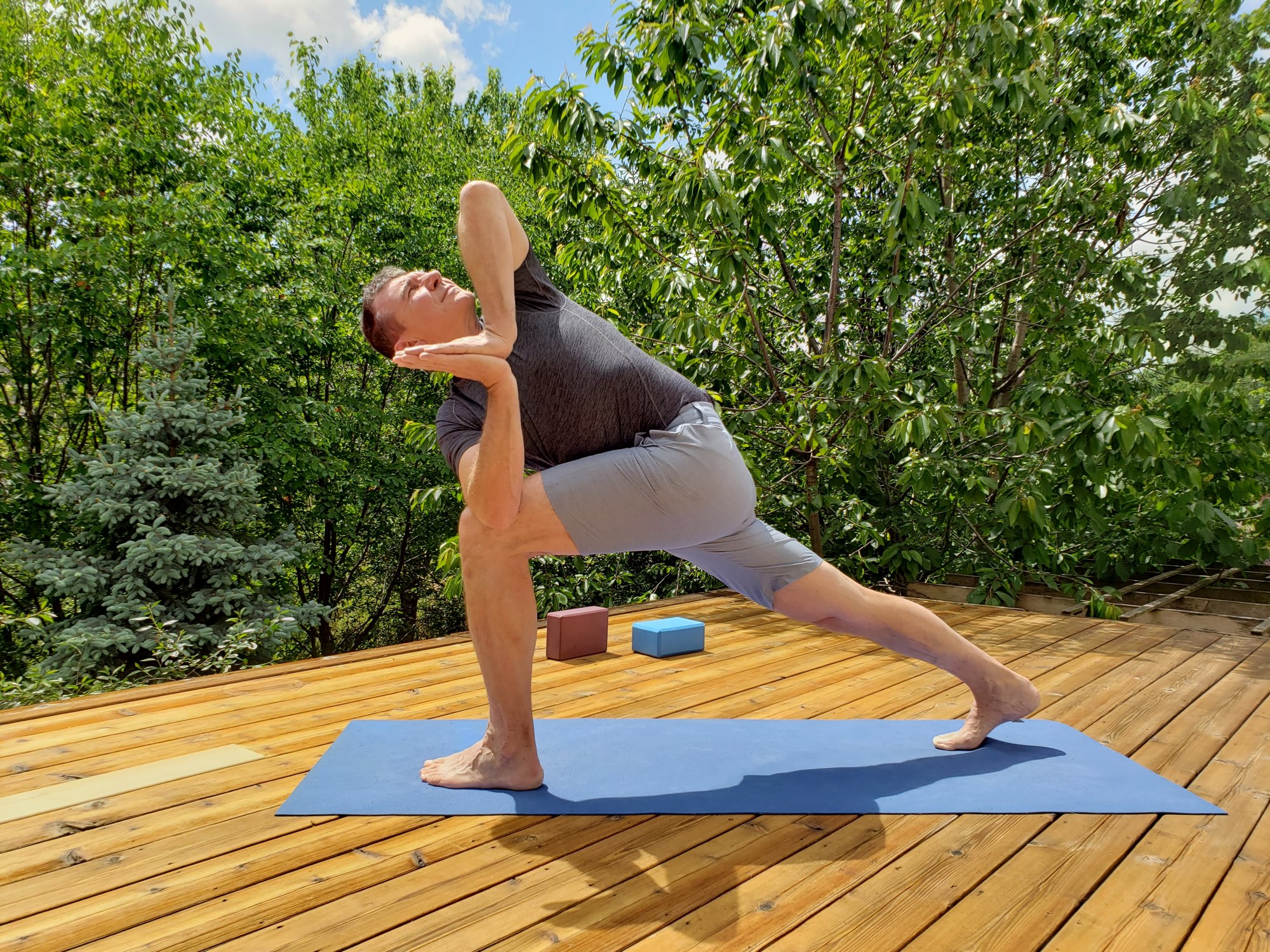
In short: revolved side angle is a deep lunge with a twist: the front knee bends to a right angle, the opposite elbow or arm hooks outside the front knee, and the chest turns toward the ceiling. It is an intense twist that asks for strength, balance and flexibility at the same time. Start with the palms together and the back knee down or a block under the hand, and build up slowly.
Below we explain the name, the two main ways it is taught, the cues that make the twist work, the precautions and where it fits.
The name
The Sanskrit name is Parivṛtta Pārśvakoṇāsana: parivṛtta means revolved, pārśva side and koṇa angle. Light on Yoga rates it Eight*, twice the difficulty of extended side angle, which tells you how demanding the full version is. It is part of the Ashtanga standing sequence (sometimes called Parsvakonasana B there) and appears in many vinyasa and hatha classes.
Two ways in, and how to twist
Light on Yoga enters from a wide stance (4 to 4½ feet) facing the side, turns the back foot 60 degrees in, bends the front knee to a right angle and brings the opposite armpit over the outer front knee with the palm on the floor outside the front foot, top arm over the ear. Yoga Journal teaches a lunge-based entry: step forward from downward dog, rise into warrior I, bring the palms together at the breastbone, then twist and hook the opposite elbow outside the front knee, working toward the back heel on the floor.
Either way, lengthen first and twist second. With the palms together, press the lower elbow into the outer knee and the knee back into the elbow, and use each inhalation to lengthen the spine and each exhalation to turn a little further, as Yoga Journal describes. Keep the front knee over the ankle and the back leg straight and strong. Only when the twist is comfortable does the lower hand go down to a block or the floor and the top arm reach over the ear. Iyengar gives half a minute to a minute; Yoga Journal 5 to 10 breaths.
Props and steps on the way to the full pose
Balance is the first hurdle for most people, especially with the back heel lifted. Yoga Journal’s teaching tips offer several ways to make the pose steadier, and you can move through them one at a time as the twist becomes familiar.
- Back knee down. Rest the back knee on the mat or a folded blanket. Keep the front knee stacked over the front ankle and the hip points level and facing forward.
- A block inside the front foot. Place a block on the inside of the bent front leg and, as you twist, put the lower hand on it. The other hand can rest on your heart or hip instead of reaching up.
- A chair. Rest the lower hand on the back or the seat of a chair as you turn. Placing the top hand on the sacrum reminds you to keep the hips level and facing forward.
- Support for the back heel. If the heel will not reach the floor, stand it on a sandbag or a thick book, or brace it against a wall. When the heel can stay down, turn the back foot in more than in most standing poses, about 45 to 60 degrees.
One more honest note. You will often hear that twists “wring out toxins” or detox the organs. In the same Yoga Journal article, functional-medicine doctor Eric Grasser points out that there is no scientific research showing that twisting poses improve liver or lymphatic function. Practice it for what it plainly does: it strengthens and stretches the legs, works the spine through rotation and asks for steady breathing under effort. If you notice you are holding your breath, back off until the breath flows again.
Precautions in plain words
Yoga Journal advises that if you have neck problems you should not turn the head to look up, but look straight ahead or down, and that you may want to avoid the pose with a headache, high or low blood pressure or insomnia. With back or disc problems, keep the twist small or choose a gentler twist. With knee problems, use the back-knee-down version. Closed twists that compress the belly are usually avoided in pregnancy; ask your teacher for an alternative.
Preparation and what comes next
Prepare with revolved lunge (back knee down), revolved chair and extended side angle. Afterwards, downward-facing dog or wide-legged forward fold let the spine unwind. The pose is a step toward twisting arm balances such as side crow.
Yoga Journal also lists half lord of the fishes as a preparatory pose: a seated twist with no balance to manage, so you can learn the rotation of the spine first.
Where it is taught
Revolved side angle is in Iyengar yoga, the Ashtanga standing sequence and many vinyasa, power and hatha classes.