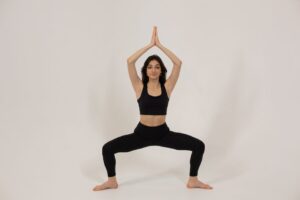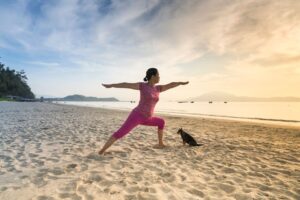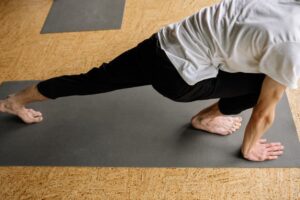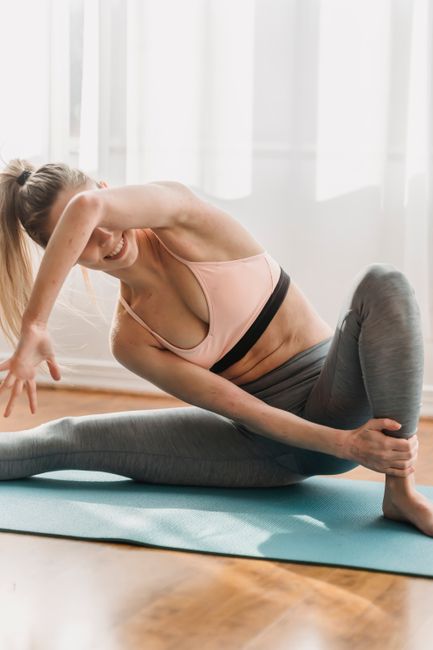
In short: side lunge is a deep sideways lunge from a wide stance: one knee bends deeply with the foot flat, the other leg stays straight out to the side, and the hips sink low between them. It stretches the inner thigh and hamstring of the straight leg and asks for deep, comfortable bending in the other knee. Hands on the floor or blocks for support, heel of the bent leg down, and only as low as the knee is happy.
Side lunge has become a favourite in flowing classes as a way to move from one side of the mat to the other. Its Sanskrit name causes real confusion, so we start there.
The name: Skandasana means two different poses
In many modern classes, and on both Yoga Journal and Yoga International, the side lunge is called Skandāsana, after Skanda (Kārttikeya), the Hindu god of war. But in Light on Yoga, Skandasana is a completely different and very advanced posture: a seated forward bend with one leg placed behind the head, rated Sixteen*. In the Ashtanga Third Series (Sthira Bhaga), AshtangaYoga.info likewise describes Skandasana as a forward bend with one leg behind the head. So if an advanced Ashtanga or Iyengar teacher says Skandasana, they do not mean this lunge. We give the name with that warning and file the leg-behind-the-head poses under leg behind the head.
Making the side lunge work
Yoga International starts from wide-legged forward fold: come up onto the fingertips, lengthen the spine, then bend one knee into the lunge. Turn the toes of the bent leg out slightly so knee and toes point the same way; that matching direction is the key safety cue. The straight leg can keep the foot flat or, for a deeper stretch, turn so the toes point up with the heel on the floor. Yoga Journal describes the shape as part squat, part lunge, facing the long side of the mat.
Keep the heel of the bent leg down if you can; Yoga Journal suggests blocks under the hands so you can sit more upright and keep that heel grounded without overloading the knee. Press the straight-leg heel into the floor and keep that thigh gently engaged. Stay for a few breaths, then shift through the centre to the other side, or walk the feet in and stand up.
Yoga International adds a few details that make a big difference. Do not lock or overstraighten the knee of the straight leg: dig that heel into the floor to wake up the back of the thigh, and draw the kneecap up to switch on the front of the thigh. The foot of the bent leg can stay flat, or you can lift the heel and come onto the ball of the foot. Once you feel steady with the hands down, you can lift them off the floor to make the balance harder, either with the palms together at the heart or with the arms reaching out to the side, as if you were drawing a bow. Yoga International files the pose as a standing hip opener with a neutral spine that works the feet, ankles, hamstrings, hips and quadriceps.
Common mistakes, explained
- The bent knee falls inward. When the knee and toes stop pointing the same way, the twist goes into the knee. Turn the foot out a little more and guide the knee over the second and third toes.
- Chasing depth. How low you go depends on your hips and ankles, not on willpower. Stop where the bent knee feels easy and bring the floor up to you with blocks.
- Rounding to reach the floor. If the chest collapses to get the hands down, the spine stops lengthening. Blocks let you sit taller, which is the point of Yoga Journal’s block cue.
- Rushing the switch. Swinging fast from one side to the other loads the knees suddenly. Keep the hands down and move slowly through the middle.
- Holding the breath. If you cannot breathe slowly and evenly, you have gone further than your body wants today. Come up a little.
Precautions in plain words
This pose needs deep, pain-free bending in the knee: if you have a knee injury or feel pain in the bent knee, stay higher with the hands on blocks, or skip it. Yoga International advises staying with the simpler version if the deeper foot position bothers the knee or the hamstrings. With groin or hamstring strains, keep the lunge shallow. With balance problems, keep both hands on blocks or a chair.
Preparation and what comes next
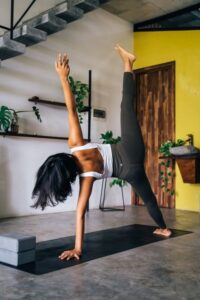
Prepare with wide-legged forward fold, garland pose (a deep squat) and goddess pose. Side lunge appears in many moon salutation sequences and can be used as a transition into half moon, as Yoga Journal shows. Afterwards, stand up through wide-legged forward fold.
Side lunge works best once the legs and hips are already warm, so it usually sits in the middle of a practice rather than at the start. A simple way to ease in is to shift slowly from side to side a few times, only halfway down, before you stay on each side for a few breaths. If deep knee bending is not comfortable for you, goddess pose and wide-legged forward fold give the inner thighs a gentler stretch without the deep bend.
Where it is taught
The side lunge is a modern posture of vinyasa and hatha classes and of many flowing moon salutations. It is not part of the Iyengar or Ashtanga syllabus under this shape.