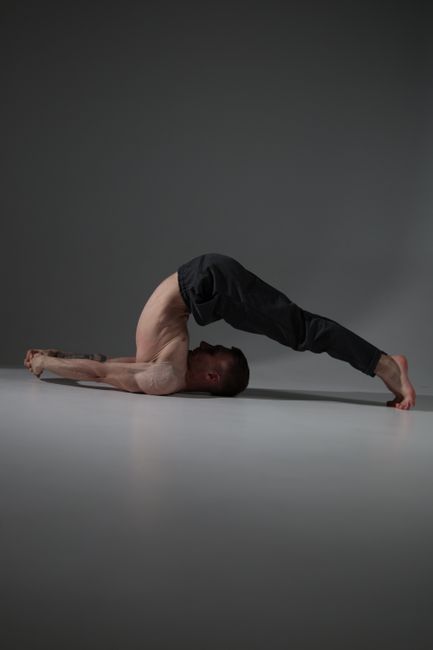
In short: snail is the yin version of plow pose. You lie on your back, lift the hips and let the feet travel over the head while the whole spine rounds, then rest there for a few minutes with the weight on the shoulders. It is an inversion that loads the neck, so it is not a beginner pose and not for everyone.
Below: how snail relates to plow, the stages Bernie Clark teaches, how long to stay, and the long list of reasons to skip it.
The name and the related asanas
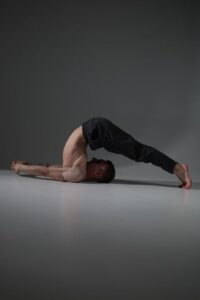
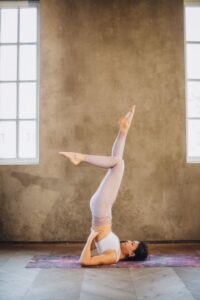
Snail is an English yin name with no Sanskrit of its own. Paul Grilley calls it the yin variation of Halāsana (plow), and Clark also points to ear pressure pose (Karṇapīḍāsana), where the knees come down by the ears. In plow the back is usually lifted and long; in snail the spine is allowed to round and the legs to soften.
Setting up and the stages
Lie on your back, lift the hips and support them with the hands, and let the feet fall over the head. Clark asks you to notice how much weight is on the neck: the weight belongs on the shoulders. He teaches three stages: hands supporting the back; feet lowered toward the floor or a bolster; then the knees bending toward the floor. Grilley warns that it can take months for the feet to reach the floor and that the neck’s tissues strain more easily than those of the upper back. Many schools teach plow with folded blankets under the shoulders to reduce the bend in the neck; that setup suits snail too. Beginners, Clark says, can do caterpillar instead.
The long hold
Grilley suggests one to three minutes; Clark gives three to five. Start at the short end. Keep the head still, facing straight up, and the breath calm; if breathing becomes difficult or the neck complains, come down.
In snail you are not trying to make plow. Clark’s note is to let the spine round fully and not try to keep the spine straight and the hips high. That rounding is the point of the yin version: he calls it one of the deepest releases of the whole spine. Because the shape is so deep, it is fine to stay at the first stage, hands on the back, for the whole hold. Only move to the next stage if the neck feels comfortable and the breath stays easy.
If the feet reach the floor with straight legs, Clark says the hands can come to the floor behind the back, apart (easier) or clasped. He warns that clasping the hands can aggravate rotator cuff problems, so keep them apart if your shoulders are sensitive. Never turn the head to look around while you are in the pose; the neck is carrying weight.
Coming out and the rebound
Keep the knees bent, hold the hips and roll down slowly, one part of the spine at a time. Clark notes that the head will likely lift as you come down; do not strain to keep it on the floor. Rest on the back with the knees bent. Clark follows with windshield-wiper knees, gentle backbends and a gentle fish to release the neck (our supported fish is a good choice), then child’s pose.
Precautions in plain words
Do not practise snail with neck problems, high blood pressure, glaucoma, vertigo, a cold or upper-body infection, a back that should not round, after eating or during pregnancy; Clark lists all of these. Learn plow or shoulderstand with a qualified teacher before trying it. This page is general information, not individual advice.
Before, after and where it is taught
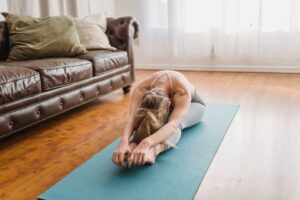
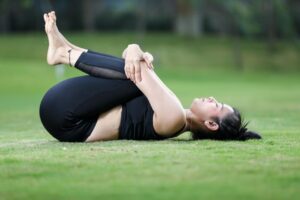
Clark suggests preparing the neck first with a few gentle forward bends of the head, chin toward the chest. If you want a milder alternative that still rounds the lower back, he suggests happy baby, which lets the sacrum lift off the floor with no weight on the neck; caterpillar is the other non-inverted option. If the neck feels weak afterward and fish is too much, he offers upward-facing cat instead.
Snail usually comes late in a yin class, after the spine has warmed up with folds like caterpillar, and before a long rest. Its active relatives are plow and shoulderstand. You will meet it in yin yoga classes, which hold mostly floor poses for several minutes with the muscles relaxed, and in some gentle and restorative classes.