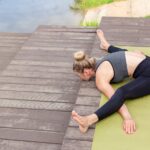
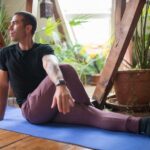
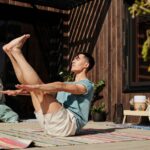
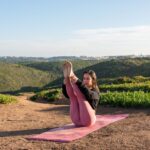
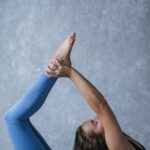
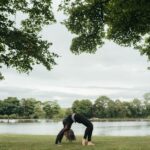
The Ashtanga Primary Series, called Yoga Chikitsa, is the first of the fixed series in the Ashtanga vinyasa system of K. Pattabhi Jois. After the sun salutations and the standing sequence, it moves through a group of standing balances and warriors, then a long run of seated forward bends, twists and hip openers, a few arm balances and lotus postures, and ends with a backbend before the finishing sequence. A full practice takes around 90 minutes. This page lists the order as given on the practice sheet of AshtangaYoga.info (Dr. Ronald Steiner) and cross-checked with two teacher guides.
The name, and what it does not mean
Chikitsa means treatment or therapy, so Yoga Chikitsa is usually translated “yoga therapy”. It is the traditional name of the series, not a promise that it treats any condition. And “Primary” means first in the system, not easy: the series includes full lotus, a posture with both legs behind the shoulders (Supta Kurmasana), rolling in lotus (Garbha Pindasana), arm balances and wheel. In the traditional Mysore-style class, a teacher gives each posture when the student is ready, and the AshtangaYoga.info sheet marks a point after Purvottanasana beyond which you continue “only when a regular practice has been established”. Beginners usually practise a shortened version that jumps from wherever they stop to the finishing sequence.
The shape of the series, group by group
The order makes more sense once you see its groups. AshtangaYoga.info describes each posture briefly, and read in sequence they form a clear arc.
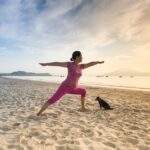
- Standing balances and warriors. A one-legged balance holding the big toe, with the leg forward and then out to the side; a standing forward bend with the other leg in half lotus; then chair pose and warriors A and B, where the stance widens and the arms lower to the sides.
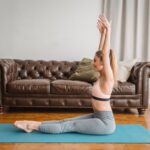
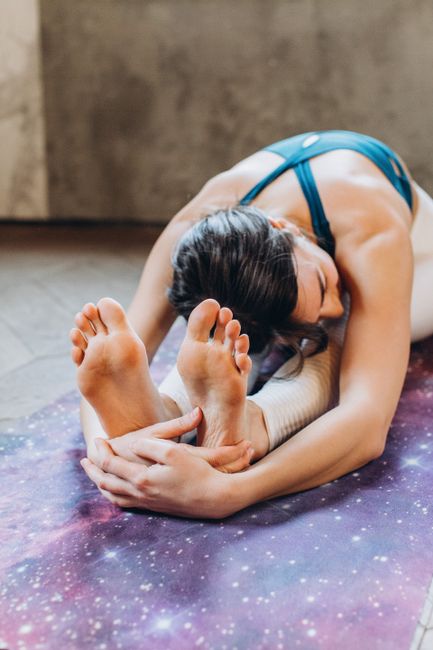
- Seated forward bends. Staff pose, then the seated forward bend in several grips on the feet, followed by Purvottanasana, which stretches the whole front of the body as a counter. Then come the one-sided folds: half-bound lotus, the three-limbed fold with one leg bent back, and the three head-to-knee variations.
- Marichi’s poses and the core. Four postures named after the sage Marichi, all with one knee drawn in close to the body: A folds forward, C twists, and B and D add a half lotus. Boat pose balances on the sitting bones in a V shape.
- The demanding middle. An arm balance with the thighs over the upper arms, tortoise and reclining tortoise, the rolling embryo in lotus and the rooster arm balance.
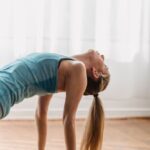
- Hips, legs and a backbend. Bound angle and seated wide angle variations, the reclining angle and reclining big-toe poses, two more big-toe balances on the sitting bones, a bridge, and finally wheel, before a last seated forward bend.
How the counting and sides work
Most postures are held for five breaths with ujjayi breathing and a set gaze point. Asymmetric postures are done on the right, then the left. Between seated postures (and between the sides of many of them) a short vinyasa links one to the next: lift, jump back to chaturanga, upward dog, downward dog, jump through to sitting. Each posture has a traditional number of counted movements (vinyasas), which a led class counts aloud in Sanskrit. Some postures have a different rhythm: Navasana is repeated three to five times with a lift between, Garbha Pindasana rolls nine times in a circle, and Urdhva Dhanurasana is repeated three to five times.
Differences between sources
The order of the postures is the same in the sources we checked. Small differences remain in the lettered variations: AshtangaYoga.info lists Paschimottanasana A to D and Baddha Konasana A to C, while other teacher guides list A to C and A and B; Supta Parsvasahita and Utthita Parsvasahita are named as separate items on the AshtangaYoga.info sheet and folded into Supta Padangusthasana and Utthita Hasta Padangusthasana elsewhere. Some books place Utthita Hasta Padangusthasana to Virabhadrasana B with the standing sequence. Your teacher’s version is the one to follow.
Practice days follow the Mysore tradition too: Sharath Yoga Centre in Mysore, the school of Pattabhi Jois’s grandson and student Sharath Jois, closes on moon days. Our moon days page lists the dates.
How to practise it safely
- Never force lotus or half lotus: the knee is the joint that gets hurt. Use the cross-legged alternatives your teacher gives you.
- Postures marked “teacher” in the steps (Marichyasana D, Bhuja Pidasana, Supta Kurmasana, Garbha Pindasana, Kukkutasana, Urdhva Dhanurasana) should be learned with a teacher present.
- High blood pressure, back or neck injury, or pregnancy: ask a health professional and an experienced Ashtanga teacher; many postures need to be changed or left out.
- The jump-backs load the wrists and shoulders: step back while learning.
This page has not yet been reviewed by a qualified teacher.
Easier alternatives
Practise the sun salutations, the standing sequence and the short finishing sequence for novices, or join a led half-primary class. For the overall structure, see the Ashtanga overview.